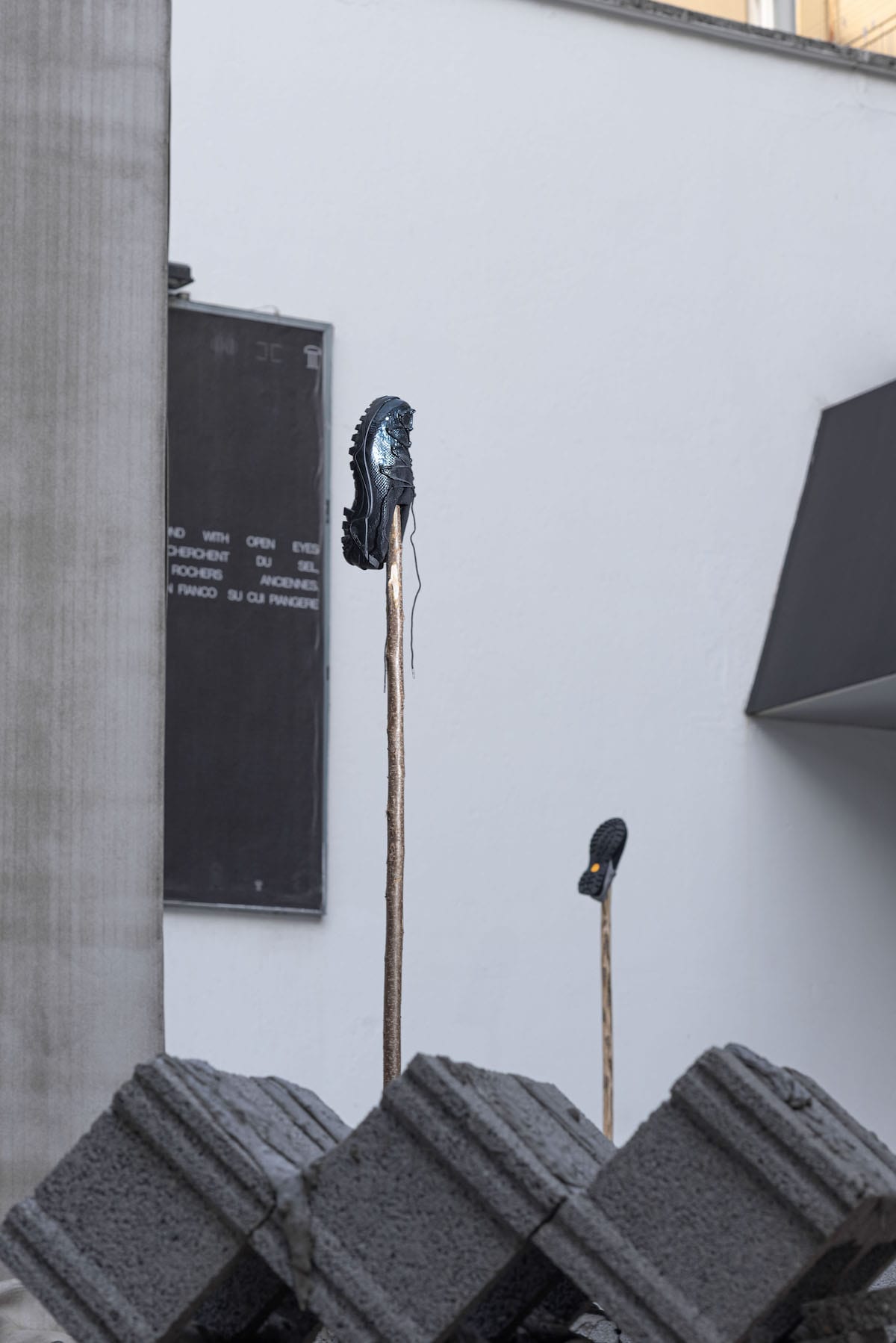
To introduce its SS22 collection, Demon partnered with sculptor and architect Marc Leschelier for an installation at Spazio Maiocchi. The event features a conversation between Marc Leschelier and Demon’s creative director, Alberto Deon, freewheeling on the origin and ambitions of their collaboration.
Employing his peculiar artistic vocabulary, Leschelier reinterpreted the brand’s narrative and eclectic research, centered around core values of memory, experimentation, heritage, and territorialization.
The talk was hosted by architect and educator Giles Nartey, who curated a selection of questions aimed at discerning the nuances behind the collaboration.

GN
How did your relationship start?
ML
We met in Paris and we started a conversation about architecture and shoe design, especially the evolution of these industries together. I found similar the fact that Demon is using prefabricated soles from Vibram and that we have also in architecture prefabricated elements that we are combining together to produce a new design. My architecture vocabulary is also made of prefabricated elements, and I was curious to see how shoe industry has been capable to produce so much variety and how they succeed to make small capsule collections out of customisations of prefabricated elements. I think architecture industry has a lot to learn from shoe industry.

ML
We have the same constraints with the cost of the moulds for example, to produce a mould for concrete blocks is as expensive as the cost for new sole mould. But it seems that shoe industry has been more innovative by importing knowledge from other disciplines, which allow them to expand their vocabulary.
GL
What about your established method of working have you brought to this collaboration and how has it been different form your previous works?
AD
To start off, this work has been the mightiest in Marc’s production so far. Moreover, in this instance he tried combining the two expressive languages that characterise his art: the rigidity of bricklaying on the one hand, and the fluidity of concrete textile on the other. In a way I think I encouraged and facilitated this new expansion in his modus operandi. I hope at least! Personally I was very compelled by the idea of a corral.
ML
Alberto gave me a carte blanche, but at the same time our discussions pushed me to bring the vocabulary of the blocks and of the textile together. It hasn't been so different in terms of process for me, but it is changing everything when you have a great commissioner that has the same expectations as you. We wanted to make an architectural installation that will speak for itself. Like a shoe, that generally doesn't need any words to be understood. Which is also something that I was criticising in architecture, it is the distance between the concepts and how things are executed.
GN
What is the importance of materiality in your work?
ML
Materiality is very important in my work but at the same time it is not the central point. Many people things my work is about cinder blocks and concrete, and about the abraisiveness of this material, which is also true, but actually the main subject of my work is about the practice of architecture. My work is very related to the situation of architecture today. It is a kind of response to this field which has been not anymore considered as a creative act. But on the contrary, a discipline under a whole system of laws that makes it impossible to be free. The message of my work is about freedom, which is something that should be discussed again in the architecture field. Which means that materiality is the vehicle of the message, and not the subject.

GN
What are your key references?
ML
The works of architecture which has been very important to me, are moments when architecture could become something else. When architecture becomes a sculpture for example. These moments of transformation are rare to observe. For example, when Michelangelo, is building a staircase for the Laurenziana library in Florence, he is building it as a sculptor, the architecture vocabulary becomes somehow blocked by absorbing sculptural properties and qualities.
Windows are blocked, decorative elements are contradicting themselves and the stairs are not attached to the wall but detach like a standing sculpture. And at the same time, my key references belongs also to the art field. Moments of liberation, like the viennese activism, with all the risks it brought on
AD
My references tend to span from movements and line of thoughts rather than other designers. I think I am inspired by the idea of mannerisms. Mannerism as an attitude more than a movement, it’s a special artistic-born behaviour that rises within the body od work of artistic movements in their maturity and seeks for imperfection to elaborate on. In this sense, it contrasts the status quo of a certain artistic language and probs alternative directions. That’s what I’m trying to do with Demon.
GN
What is the relationship between digital and physical in your practice?
ML
I'm using the digital to detail and to express my work sometimes, but I use mainly physical models and mock-ups to develop my work. The digital can be as dumb as a way to count easily the blocks I have to use in an installation. I would be interested to use the digital in my work to see how it can propose new practices and possibilities to escape the normative context of architecture. But for the moment, I'm focused on the development of a physical vocabulary. Which is engaging myself in a thinking where I have to built another meaning out of prefabricated architectural vocabulary.

AD
Coming from architecture education, I digested so much digital simulation that when I approached this project I was reluctant to approach design via any sort of screen. I significantly prefer to explore the raw materials and work design ideas from the ground up, starting from physical instances and scraps of materials, soles, minuteria. So I can - say - start from a sculptural phase in which I condense feelings and impressions into matter without caring about serialisation. After this phase there is the “pain” phase in which I have to review the chimeras I created and reverse-engineer an industrialised version. Nonetheless I don’t exclude hybridising my work method with digital tools, I’m thinking especially of 3D modelling. I hope to interweave these two realms and start working in a “phygital” process that allows me to maximise both inputs. On the other hand, I’ve used in the past digital tools to enhance our communication, but I see digital alteration and technologies becoming increasingly less relevant as the brand grows; I’d rather allow the products speak for themselves. Because it is products we’re dealing with at the end of the day.
GN
How do you relate to the concept of community, and how does it affect your practice?
ML
I think a community is very important, to not feel alone and isolated in your own desires. But I have to say that I don't see a lot of architects who wants to be out of the system of architecture. I don't want to be only considered as an artist or a sculptor, I want also to be considered as an architect, and someone who is engaged in the act of construction and in the development and expansion of architecture vocabulary.

AD
Design is rarely revolving around design. Or better, design is just one side of design as a cultural expression. What gives meaning to design are the social attributes that it stems from, and the social groups it represents. It’s much broader than a pencil dictating shapes on a sheet, the nuances are much more than what floats in a Rhino7 interface, no matter how equipped with state of the art plugins. To a certain degree over-design leads to boredom. Now more than ever forms need to become (de)sign, thus “sign-ify” something other than the form in and of its own.
I’m discovering the very meaning of the idea of community very recently. I think having debuted in this market via Slam Jam is having a huge impact on my understanding of fashion. In a way, the cultural load of a certain community represents the other half of design. Social status, value systems, lifestyle, group membership all encompass the anthropological load of a certain piece of design. Nowadays, with all sorts of industrial facilitation, giving shape to object and its degree of aesthetic specificity is unprecedented. This undermines the gesture of design tout-court, and moves the focus to what that specific shape represents, what values and feelings it broadcasts. Communities are catalysts for this process to happen.
GN
You both come from an architectural background, in which way has the concept of manifesto is still relevant in the 21st century?
ML
It's true that manifestos are very important in the architecture history. Architecture has been structured and pushed by the treatises and manifestos, but it seems that today they are less popular and written. It is related to our epoch, which doesn't have any time left for reading and writing thoughts, everything is about immediacy and visual communication. It's almost the model of telepathy. Everything should be direct and consumed with no patience. Sad or not ? I don't know, we're probably losing a lot but it is the rules of our time and everyone can still make great work out of this context.

AD
Manifestos are rooted in a context in which ideas in and of their own had a much grander allure. Discussing ideas even when this implied dwelling on tortuous intellectual mazes was an important process in the act of generating culture. I think nowadays this procedure has fallen apart, in favour of immediacy. Mostly because liberalism thrives on novelty and novelty requires speed and momentum. I am inspired by the old usage of creating a “Corpus Theoreticus” before putting things into the world, that’s why I always try to test my ideas in my mouth. Speak them out loud, looking for syllogistical immediacy between thoughts, cause I know that will result in a clearer vision.
